
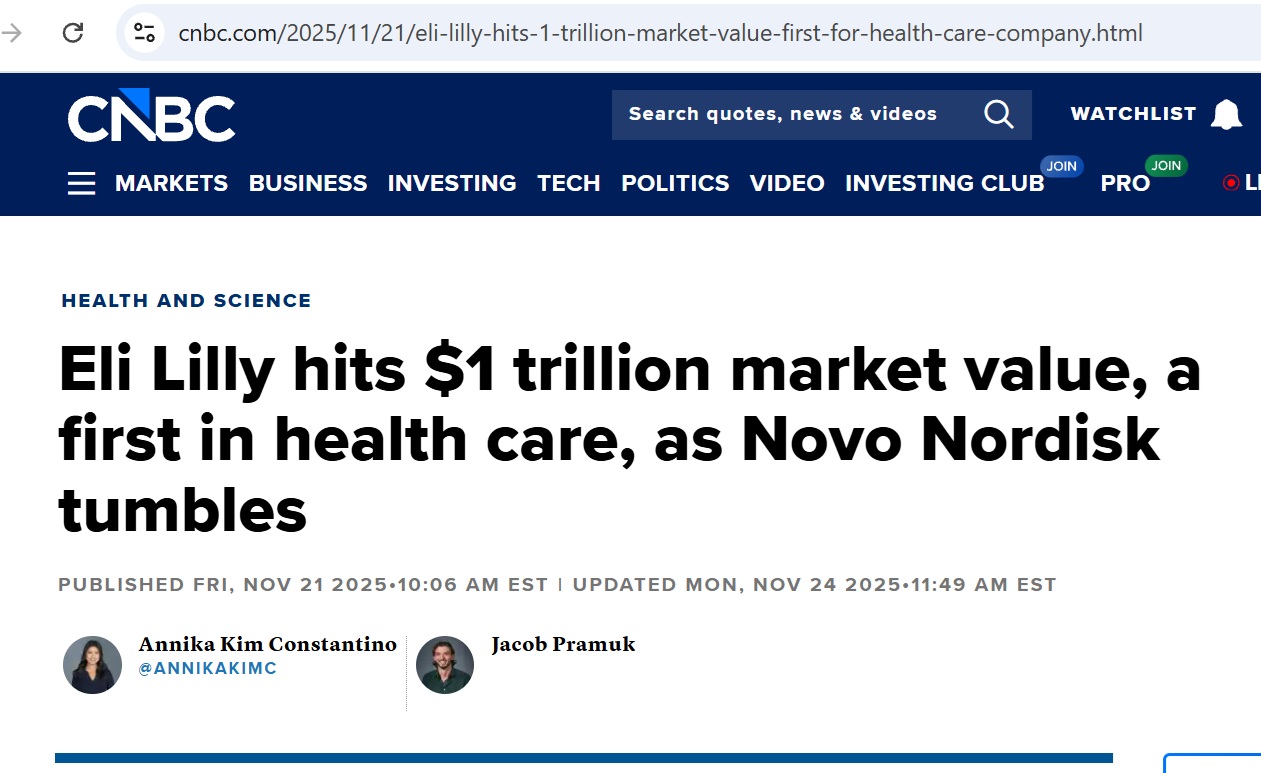
Eli Lilly's current market dominance highlights a classic pivot from a
"Red Ocean" (fierce competition) to a "Blue Ocean" (uncontested space).
By shifting from traditional diabetes management into breakthrough
obesity treatments, Lilly created massive, untapped demand and
established a distinct, highly profitable market.
The GLP-1 "Blue Ocean" For years, Eli Lilly and rival Novo Nordisk
fought in the saturated insulin and diabetes market - a classic "Red
Ocean" characterized by price controls, patent cliffs, and competitive
convergence. Lilly redefined the space by targeting weight loss not just
as a cosmetic issue, but as a chronic metabolic disease.
The Innovations: By developing tirzepatide (sold as Mounjaro and
Zepbound), Lilly achieved unprecedented weight loss efficacy that far
outstripped older therapies.
Market Creation: Rather than fighting solely for incumbent diabetes
patients, this unlocked millions of previously unaddressed patients,
effectively creating an entirely new, multi-billion-dollar market where
competition was initially irrelevant.
The Shift to a New Blue Ocean (2026 Strategy)As the obesity market
inevitably grows more crowded and transitions back into a "Red Ocean"
(with competitors racing to raise efficacy and capture market share),
Lilly is already executing a strategy to find their next Blue Oceans:
Strategic Acquisitions: To prevent over-dependence on its GLP-1 drugs,
Lilly has aggressively invested billions into adjacent, uncontested
medical spaces.
Targeting Sleep Disorders: Lilly acquired Centessa Pharmaceuticals for
its orexin receptor agonist therapies, tapping into a new market for
narcolepsy and idiopathic hypersomnia.
Next-Generation Oncology: By acquiring companies like CrossBridge Bio,
Ajax Therapeutics, and Kelonia Therapeutics, Lilly is building platforms
for in vivo CAR T and targeted oncology payloads, moving into novel
disease pathways.
------------
Copyright (C) All Rights Reserved - Damson Group.